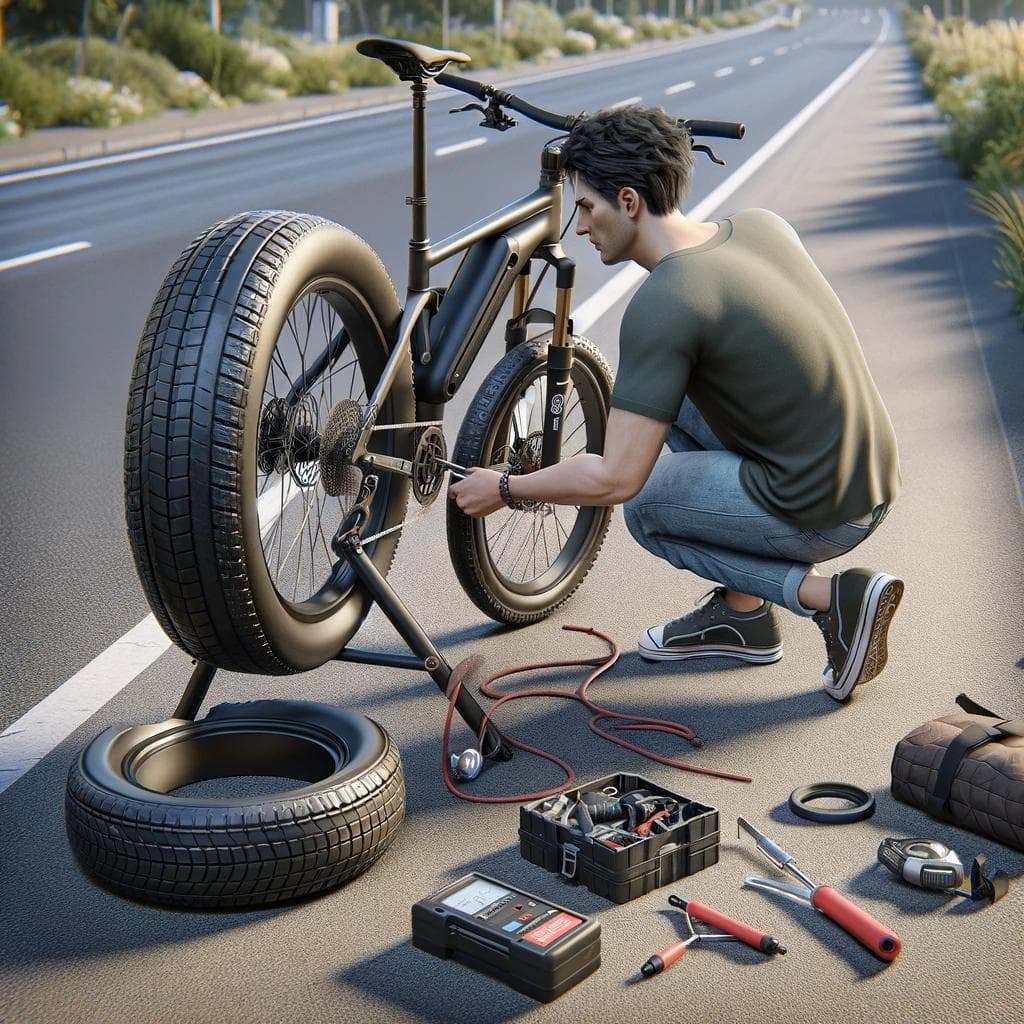
Flat tires are the most common mechanical issue for e-bike riders, and they are more disruptive than on a regular bike. Removing an e-bike wheel — especially a rear wheel with a hub motor — is significantly more complicated than on a standard bicycle. Some hub-motor wheels require disconnecting electrical cables, and the added weight (20–28 kg) makes roadside repairs physically harder.
Tubeless tire setups eliminate the majority of flats by using liquid sealant inside the tire to seal small punctures instantly. But they also come with their own maintenance demands. This guide compares tubeless and tubed tire setups specifically for e-bikes, with real product recommendations for each approach.
How Each System Works
Tubed (Clincher) Tires
The traditional setup: a tire sits on the rim with a separate inner tube inside. When something punctures the tire, it pops the inner tube and you get a flat. Repair requires removing the wheel, extracting the tube, patching or replacing it, and reinstalling.
Tubeless Tires
The tire seals directly against the rim (using tubeless-compatible rims and tires) with no inner tube. Liquid sealant inside the tire fills small punctures (up to about 3–4mm) as they happen. You often do not even notice the puncture — the sealant plugs it while you ride.
Advantages of Tubeless for E-Bikes
1. Far Fewer Flats
This is the primary advantage and it is significant. Tubeless sealant handles:
- Thorns and glass shards (the most common flat causes)
- Small nail punctures (up to ~3mm diameter)
- Slow leaks from minor rim or tire imperfections
For commuters who ride daily on roads with debris, tubeless can eliminate 80–90% of flats. For e-bike riders who dread the process of removing a hub-motor wheel on the roadside, this alone justifies the switch.
2. Better Ride Quality
Without an inner tube, you can run lower tire pressures without risking pinch flats (where the tube gets pinched between the rim and an obstacle). Lower pressure means:
- More comfortable ride, especially on rough roads
- Better traction in corners and on loose surfaces
- Improved grip in wet conditions
For e-bikes that are already heavier and faster than regular bikes, the traction improvement is meaningful for safety.
3. Lower Rolling Resistance
Tubeless tires have slightly lower rolling resistance than tubed tires at the same pressure, because there is no friction between the tube and tire casing. The difference is small (1–3 watts) but real.
4. Self-Sealing Means Fewer Roadside Stops
On a regular bike, a flat means 10–15 minutes of roadside repair. On an e-bike with a hub motor, it can mean 20–30 minutes, specialized tools, and greasy hands. Tubeless sealant handles small punctures while you ride — no stopping, no tools, no hassle.
Disadvantages of Tubeless for E-Bikes
1. Initial Setup Is Harder
Converting to tubeless requires:
- Tubeless-compatible rims and tires (or conversion with tubeless tape and valves)
- An air compressor or tubeless-specific floor pump to seat the tire bead
- Proper application of sealant
The first-time setup can be frustrating. Tires that refuse to seat, sealant that sprays everywhere, and bead pops that scare the neighbours are common initiation experiences.
2. Sealant Maintenance
Tubeless sealant dries out over time (every 2–6 months depending on climate and brand). You need to top up the sealant regularly. Forget this, and you effectively have a tubeless tire with no flat protection — worse than tubed because you also have no tube.
A quality sealant like Stan's NoTubes Race Sealant lasts longer than standard formulas (up to 6 months versus 2–3 months) and seals larger punctures.
3. Large Punctures Still Strand You
Tubeless sealant handles small holes. A large gash, sidewall cut, or puncture over 5–6mm will not seal. In these cases, you need a tubeless plug kit (like the Dynaplug Racer Pro) or, as a last resort, an emergency inner tube that you can install inside the tubeless tire.
Always carry a plug kit and a spare tube even when running tubeless. For more on dealing with tire issues, see our tire replacement guide.
4. Messy
Sealant is liquid latex. It gets on your hands, clothes, and rim during installation and top-ups. When a puncture seals on the ride, sealant can spray onto the frame, brakes, and your legs. It washes off with water, but it is not the cleanest system.
Best Tubeless Tires for E-Bikes
Commuting/Road: Schwalbe Marathon E-Plus
The Schwalbe Marathon E-Plus is purpose-built for e-bikes. It features a thick SmartGuard puncture protection layer, ECE-R75 e-bike certification (rated for speeds up to 50 km/h), and tubeless-ready construction. The trade-off is weight — these are heavy tires — but on an e-bike, the motor compensates. Around $50–$70 per tire.
Mountain/Trail: Maxxis Minion DHF EXO+
For e-mountain bikes, the Maxxis Minion DHF with EXO+ casing provides excellent tubeless performance with reinforced sidewalls that resist cuts from rocks and roots. The aggressive tread pattern handles loose terrain at e-bike speeds. Around $60–$80 per tire.
Best Puncture-Resistant Tubed Tires for E-Bikes
If you prefer the simplicity of tubed tires, choose tires with heavy puncture protection:
- Schwalbe Marathon Plus E: The most puncture-resistant tubed tire available, with a 5mm SmartGuard layer. Many riders go years without a flat on these tires. Heavy, but near-bulletproof
- Continental Contact Plus: Excellent puncture protection with a slightly lighter casing than the Schwalbe. ECE-rated for e-bikes
Which Should You Choose?
Choose tubeless if:
- You commute daily and cannot afford flat-related delays
- You ride off-road where thorns, glass, and sharp rocks are common
- Your e-bike has a hub motor (making wheel removal especially painful)
- You are comfortable with occasional sealant maintenance
Choose tubed if:
- You prefer simplicity and minimal maintenance
- You rarely get flats (some areas have very clean roads)
- You are not comfortable with tubeless setup and sealant management
- Your local bike shop can handle flat repairs quickly
The hybrid approach: Run tubeless tires with sealant but always carry a spare tube. If the sealant cannot handle a puncture, install the tube inside the tubeless tire as an emergency fix. This gives you the best of both worlds — automated flat protection plus a reliable backup.
Key Takeaways
- Tubeless eliminates 80–90% of flats by using liquid sealant to seal punctures while you ride
- For e-bike riders with hub motors, avoiding wheel removal alone justifies going tubeless
- Sealant must be topped up every 2–6 months — set a calendar reminder
- Always carry a plug kit and emergency tube even when running tubeless
- Schwalbe Marathon E-Plus is the best tubeless commuting tire; Maxxis Minion DHF EXO+ is the best for trails
- If you prefer tubed simplicity, Schwalbe Marathon Plus E offers near-bulletproof puncture protection
For general maintenance routines that keep your tires and drivetrain in top shape, see our beginner maintenance guide and our 500-mile maintenance checklist.